Medicare now pays monthly for the care between visits. Run it with the staff you have.
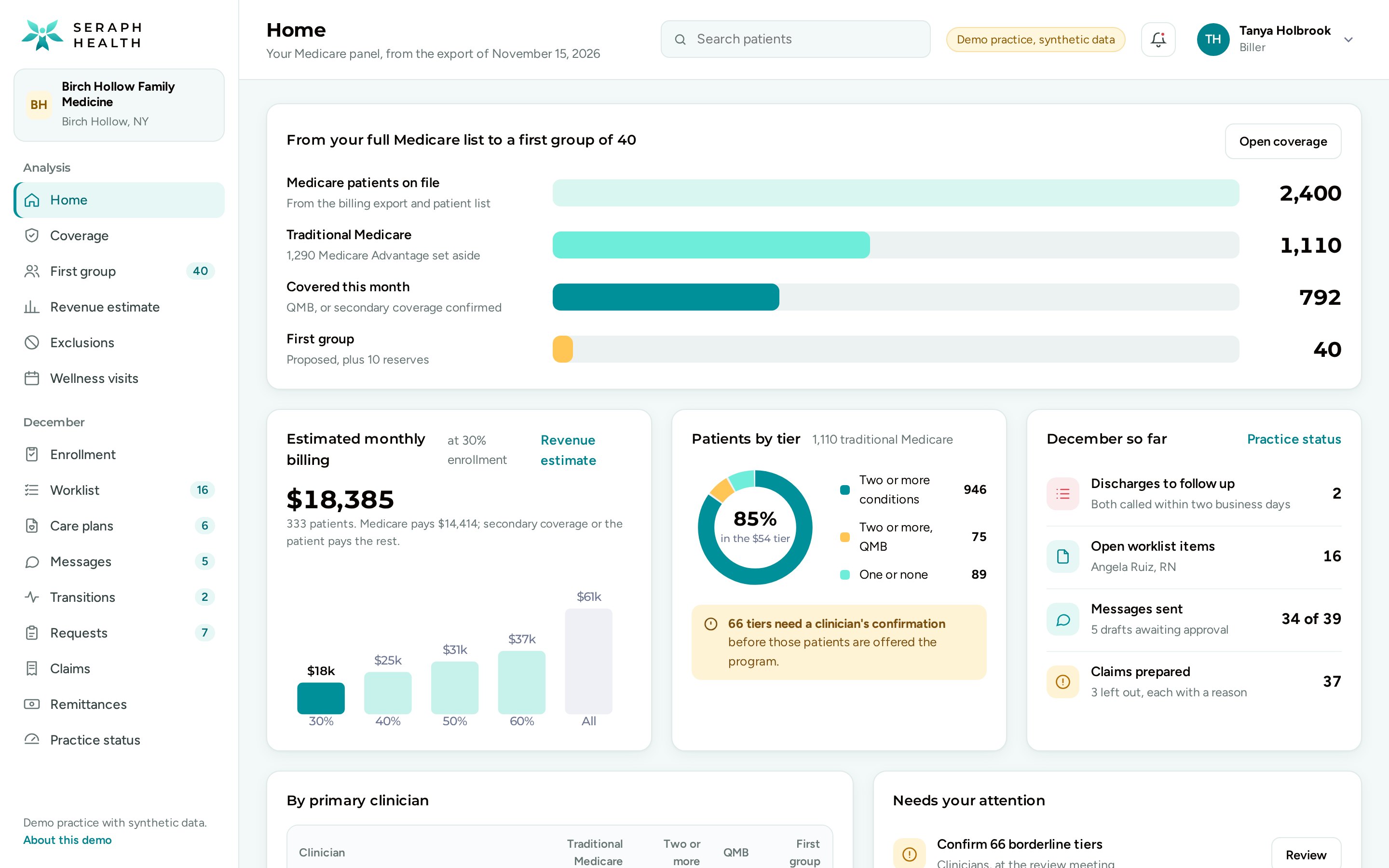
Seraph is an AI platform that lets an independent primary care practice run Medicare's Advanced Primary Care Management program (APCM) end to end: who qualifies, consent, care plans, monthly contact, documentation, claims and payments. Your practice bills Medicare and keeps the revenue.
What Medicare now pays
Since January 2025, traditional Medicare has paid primary care practices a flat monthly amount for each enrolled patient, for the work that happens between visits. No minutes to log.
for a patient with one chronic condition or none
for a patient with two or more
where Medicaid also covers the patient's cost sharing
At 2026 rates. One code per patient per month. Traditional Medicare only; Medicare Advantage plans aren't required to pay it.
of the 5,383 independent primary care practices with one to four physicians show no chronic care management billing in public Medicare data for 2024.
Why most practices aren't billing it
We looked at public Medicare billing data (CMS, 2024) for the 5,383 independent primary care practices in the US with one to four physicians. Three in four show no chronic care management billing at all.
The reason is the old code. Chronic care management paid for logged minutes, twenty per patient per month, so a practice had to hire someone to log them or hand about half the revenue to an outside vendor whose nurses called patients in the vendor's name. Most small practices did neither.
APCM pays for capability instead: can the practice provide the care plan, the follow-up and the documentation, and show that it did? Most of that is systems work, and that's the part we take on.
What Seraph does
It runs the program around your staff. Seraph:
- Finds and tiers eligible patients
- Checks secondary coverage
- Tracks consent
- Drafts care plans for your clinician to approve
- Keeps every enrolled patient hearing from your practice each month
- Follows up discharges
- Prepares the monthly documentation and claims
- Matches the payments
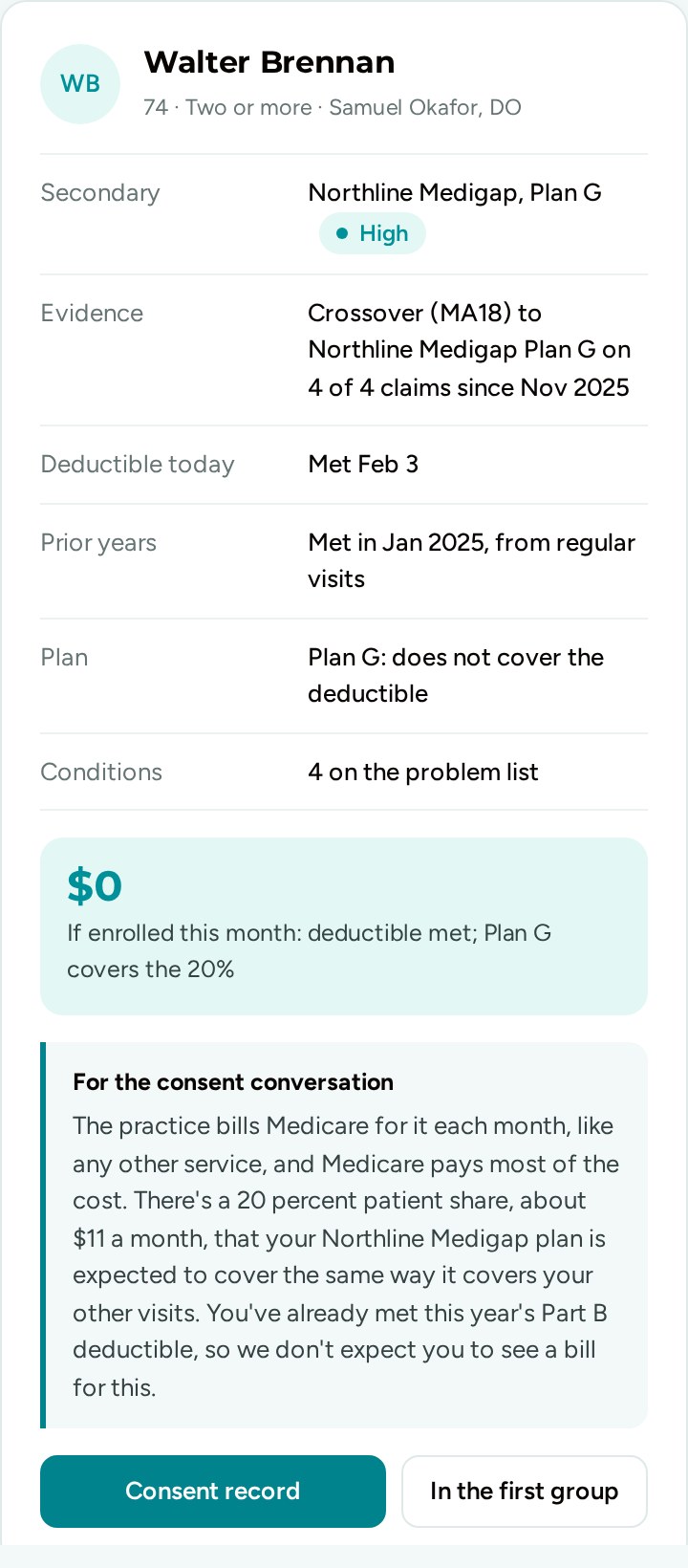
The coverage check means you know which of your patients have secondary coverage for the Medicare patient share, and whether they've met this year's deductible, before anyone is asked. There is other between-visit work it may be able to take on; working that out, and the order, is what the partnership is for.
How it works
Your records in
Under a business associate agreement, your biller exports your Medicare claims and remittances for the past year or two. Nothing is installed.
The analysis
Seraph reads them and comes back with your eligible patients by tier, which of them have secondary coverage for the Medicare patient share, and a proposed first group of 30 to 50 patients. The evidence is shown for every patient.
The monthly cycle
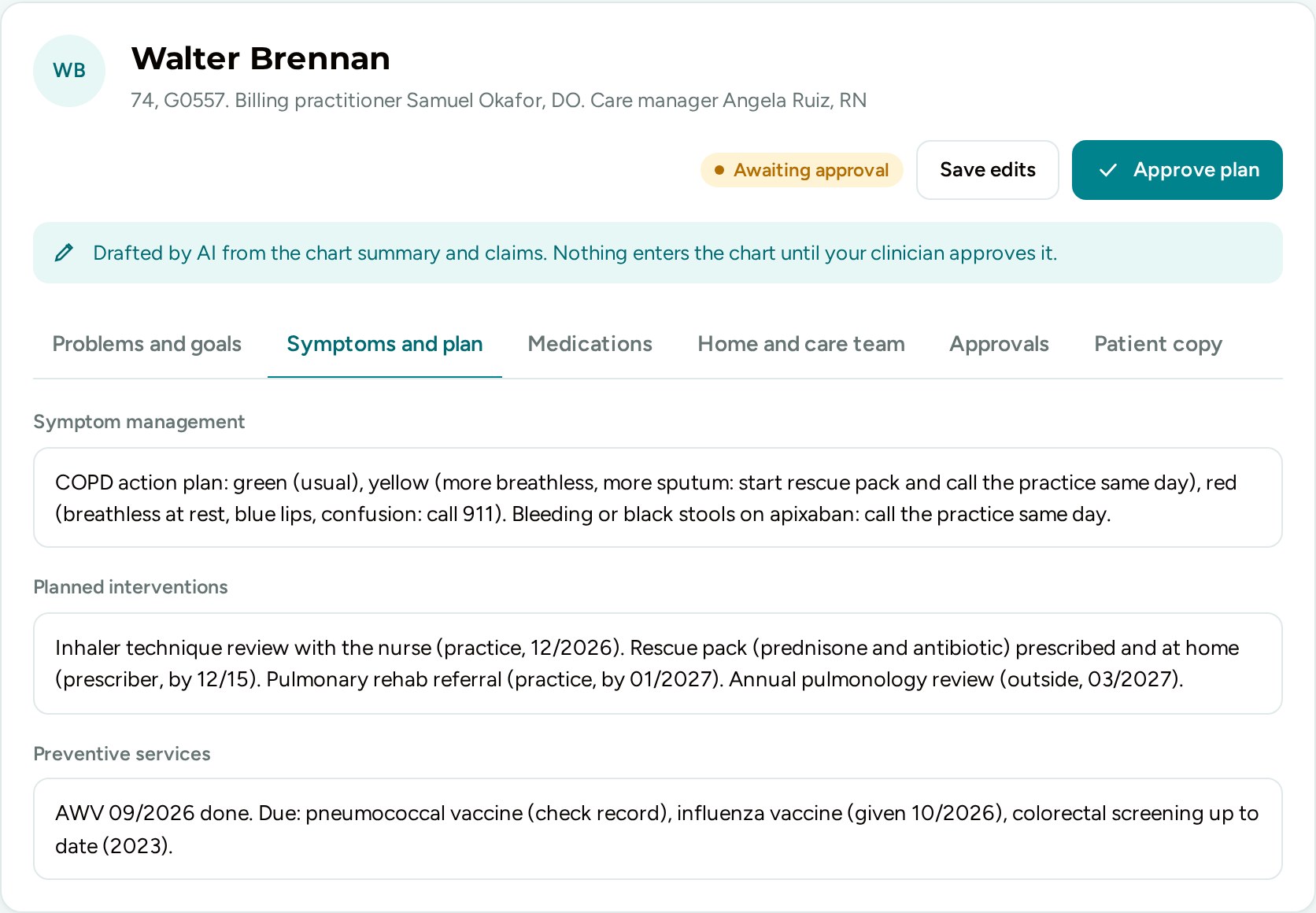
Each month Seraph produces the nurse's worklist, drafts the care plans and the monthly message for your staff to approve, prepares the claims file with Medicare's same-month rules applied, writes the documentation for each chart, and matches Medicare's payments to the claims when they come in.
Where the AI comes in
AI drafts
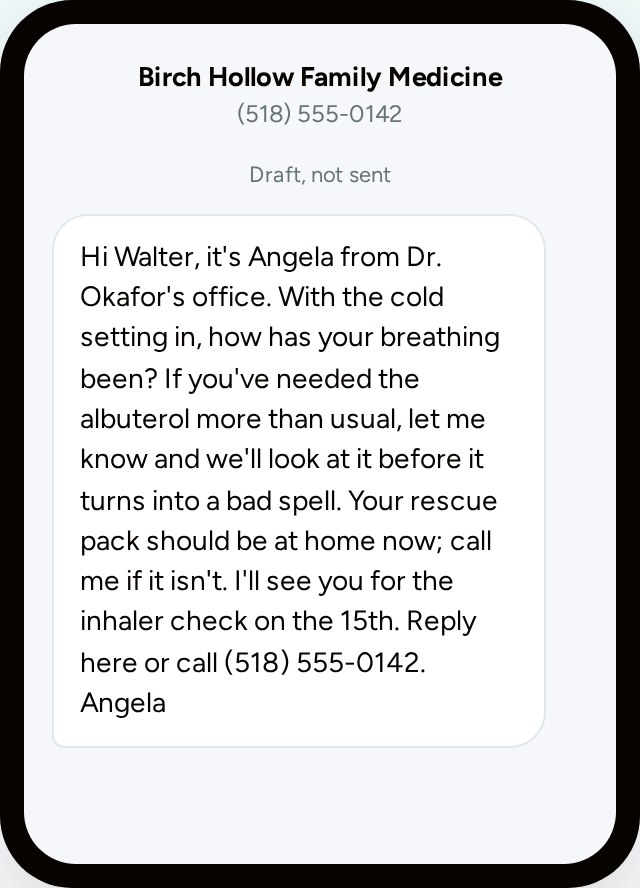
AI does the drafting: care plans, documentation, the monthly message. Your nurse edits, your clinician approves, and nothing enters a chart or reaches a patient without that approval. Your staff start from a draft instead of a blank page.
Your records decide
Who qualifies, which tier, who has secondary coverage, what can be billed this month: those are Medicare's rules applied to your own records, not a model's opinion, and every row shows where it came from.
Your patients stay yours
- Your staff keep the relationship with your patients and all clinical decisions.
- Messages to patients go out in your practice's name, with your approval.
- A member of your team is always reachable.
- Nobody calls your patients in another company's name.
Your data
- A business associate agreement with every practice, before any data moves.
- Hosted in the United States.
- Your data stays yours, and is deleted if you leave.
- If we ever stop operating, your consents, care plans and enrollment records are yours to keep.
Design partners
We're building Seraph with a small number of independent practices. One has already started with us, and we have space for a few more. Design partners get the analysis of their own patients at no cost, pay nothing while we build, decide what we build first, and pay half price for 24 months afterwards if they keep it.
- Your own numbers first, at no cost
- Nothing to pay while we build
- You decide what we build first
- Half price for 24 months afterwards
Who we are
Seraph Health is Leslie Dickson-Tetteh, a physician trained at the University of Oxford who previously founded a primary care software company, and Ji Tang, a bioinformatics PhD who builds the software. New York and Los Angeles.